---
TATTOO MEANINGS / SEA LIFE / SHARK
Raw power, dominance, fearlessness, apex authority, reclaimed fear
The great white is the most recognizable shark on earth — and the most misunderstood. A great white tattoo reads as pure power: the apex predator with no natural enemy, moving through the water with total authority. For many wearers it is about reclaimed fear — wearing the very creature the world is afraid of, flipping terror into a personal badge of edge and resilience.
The great white straddles two opposite readings. In the West it became the monster of Jaws (1975) — primal fear made flesh. But across Polynesian tattoo the shark (tohu, or mano) is a protector, and the great white simply amplifies that guardian power to its maximum. Wearing one can mean you have faced your own fear and came out dominant. Modern surf culture often reads the great white as respect for the ocean’s raw, untamed force.
Tattoo blogs love to say sharks must swim forever to breathe — so a shark tattoo means ‘keep moving.’ That is false for the great white. Like many sharks, it can buccal-pump to rest, and researchers have filmed great whites hovering nearly motionless. The ‘relentless motion’ reading is a powerful personal metaphor, but claim it as your story, not as shark biology. The real great-white facts worth inking: it is the largest predatory fish alive (females can exceed 20 feet), its bite is a sensory feat of ampullae of Lorenzini that detect electric fields, and it has patrolled oceans since before the dinosaurs.
Here is the tension that makes a great white tattoo interesting. It is the ocean’s apex predator — yet the IUCN lists it as vulnerable, and some regional populations are still a fraction of their mid-20th-century size after culling, the fin trade, and bycatch. For many wearers this is the point: the most feared animal on earth is also one of the most fragile. A great white can honor that paradox — dominance that still needs protection — rather than the snarling-monster cliché.
No animal carries heavier pop-culture baggage than the great white. Spielberg’s Jaws (1975) recast it as primal terror — and that is exactly why many people choose it. Wearing the creature the world is afraid of flips the narrative into a badge of edge, resilience, and control. It is the same instinct behind a skull tattoo: turning a symbol of fear into a personal statement of fearlessness. Tell your artist if you want a reverent, realistic great white rather than the movie-poster snarl.
Western culture sees the great white as the hunter; Polynesian tattoo sees the shark (tohu, or mano) as a protector. Across Hawaii, Samoa, and Māori tradition the shark is an ʻaumākua — a family guardian spirit — and a great white simply amplifies that guardianship to maximum strength. So a great white can mean protection of your family and safe passage, not just aggression. The niho (shark-tooth) pattern is worn as literal armor against harm.
Open-jaw, head-on great white = confrontation and reclaimed fear. Cruising side-profile = calm, patrolling authority. Swimming upward = ambition and rising through pressure; diving downward = depth and the unknown. Blackwork or solid silhouette = raw, minimal power; realistic color = reverence and awe. Decide the emotional tone before your artist sketches — it is far harder to change once inked.
In 2026 the most-requested great white designs are hyper-realistic jaws in black and grey, followed by sleek fine-line outlines and American Traditional bold-flash versions. Forearm, calf, chest, and full sleeve are the highest-traffic placements for large-scale realism; a small great white outline on the wrist reads as quiet, constant confidence. Color-wise, black carries raw strength while blue ties the predator to its ocean element and calmer energy.
Pick the species whose story matches your intent. Great white = pure power and dominance. Hammerhead = vision and protective awareness (wide-set eyes, near-360 view). Whale shark = peace and quiet strength. Mako = speed and agility. Tiger shark = survival instinct and raw adaptability. A shark-tooth (niho mano) pattern gives you pure protective symbolism without committing to a full predator. If dominance and authority are your story, the great white is the unambiguous choice.
DESIGN GALLERY
Browse design ideas and find artists who specialize in this style.
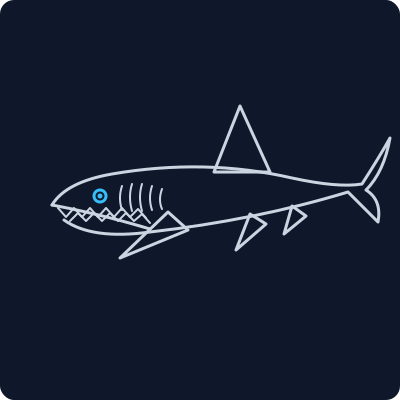
Line-art design
1,000+
monthly searches
87%
want to book after reading
0
artists showcasing here
Are you a tattoo artist?
1000+ people search for great white shark tattoo tattoos every month. Your work could be the first they see. Upload your portfolio — it is free and takes 2 minutes.
First 10 artists to upload get 3 months Pro free.
Find, price, and book the design you're exploring.
A great white reads as pure, untamed power — the apex predator with no natural enemy. Most wearers choose it for dominance, fearlessness, and reclaimed fear: wearing the creature the world fears flips terror into a personal badge of edge and resilience.
Increasingly, yes. The great white is listed as vulnerable by the IUCN, with some populations still recovering from decades of culling and the fin trade. Many modern wearers choose the great white as a quiet act of respect for a keystone ocean species rather than a monster to be slain.
This is the myth that will not die. Unlike some sharks, the great white does not need to swim constantly to breathe — it can use buccal pumping to rest. So a "keep moving" great white tattoo is symbolic, not biological fact. The relentless-forward-drive reading is yours to claim, not the fish’s requirement.
For men it most often reads as raw dominance and apex authority — top of the food chain, nothing to prove, moving through life without hesitation. Pair it with waves for element, or a compass for direction and resolve.
For women the great white is usually reclaimed power on her own terms — owning the predator the world fears, rather than a gendered dominance statement. The posture and fine-line vs bold style carry the intent more than the wearer’s gender.
A great white reads as pure power and dominance; a hammerhead reads as vision, perspective, and protective awareness. If your story is about force and authority, choose the great white. If it is about clarity and guarding others, the hammerhead fits better.
The Jaws (1975) great white is pop-culture fear incarnate — so choosing it is often about reclaiming that fear: the edge, the resilience, the control. It is the same instinct behind a skull tattoo, turning a symbol of terror into a statement of fearlessness.
A solid-black or fine-line silhouette strips the great white to its unmistakable outline: minimalist focus, quiet dominance, a little ominous. Blackwork reads as raw power and foreboding rather than the decorative tones of a color piece.
Black (or black and grey) is the most popular choice and reads as strength and raw power; blue shades connect the shark to the ocean and suggest calm, adaptable energy. Realistic great whites often use blue-grey gradients to evoke the water the animal moves through.
Yes — a wave ties it to its element and doubles the "push through life’s currents" metaphor; a compass adds direction; an anchor adds maritime roots. In Japanese irezumi the shark is a protective water-deity messenger, so pairing with dragons or koi builds a master-of-the-water composition.
Get matched with the right meaning and style for your next tattoo.
Start Your Studio Free →Sources
EEAT: Written by Sarah Chen (Founder & CEO at InkFlow | 12 Years Tattoo Studio Operations). Verified against National Geographic. Cultural and historical information is sourced from academic and specialist references and is provided for educational purposes. Meanings vary across traditions and interpretations.